
All Bombay cats are black cats, but not all black cats are Bombays. This simple distinction sits at the heart of one of the most common points of confusion among cat lovers. The Bombay is a recognized pedigree breed deliberately developed to resemble a miniature black panther. A “black cat,” by contrast, is any domestic cat whose coat is solid black, regardless of breed or mixed ancestry. Black is simply a coat color that appears across many breeds and in countless random-bred domestic shorthairs and longhairs.
This comprehensive guide explores the Bombay cat in detail and contrasts it with ordinary black cats. We cover history and development, physical appearance and breed standards, temperament, care needs, health considerations, availability and cost, and practical advice for deciding which (if either) is right for your home. By the end you will understand exactly what sets the Bombay apart and why both pedigree Bombays and everyday black cats can make outstanding companions.
What Is a Bombay Cat?
The Bombay was created in the 1950s and 1960s by American breeder Nikki Horner of Louisville, Kentucky. Her goal was to produce a cat that looked like a small Indian black leopard or panther. She crossed sable Burmese cats with black American Shorthairs. The resulting breed combined the muscular, compact body and affectionate nature of the Burmese with the solid black coat of the American Shorthair.
The breed was recognized by the Cat Fanciers’ Association (CFA) in 1970 and is also recognized by The International Cat Association (TICA) and other major registries. There is a related British version developed from different lines, but the classic American Bombay is the type most commonly discussed.
Key breed-standard requirements include:
- Completely solid black coat from root to tip, with a glossy, patent-leather sheen
- Copper to deep gold (new-penny) eyes—green or other colors are not permitted in the show standard
- Black nose leather and black paw pads
- Medium size with a muscular, surprisingly heavy build
- Rounded head, short muzzle, and a distinctive slight sway in the walk that recalls a panther
What Is a “Black Cat”?
“Black cat” is not a breed. It describes any cat whose fur appears solid black. This includes:
- Pedigree cats of many breeds that allow solid black (American Shorthair, British Shorthair, Persian, Oriental, etc.)
- Domestic shorthairs and longhairs of mixed or unknown ancestry
- Cats that may show faint “ghost” tabby markings or a rusty tinge in strong sunlight (especially if the black is not genetically solid to the roots)
Black cats can have any eye color (green, gold, yellow, hazel, or occasionally odd-eyed), any body type, any coat length, and any personality. Their noses and paw pads may be black, pink, or mixed. There is no single standard because black is a color, not a breed.
Physical Appearance: Side-by-Side Comparison
Coat Bombay: Short, dense, close-lying, and jet black to the roots with a high-gloss, patent-leather finish. Whiskers are typically black. Black cat: Coat may be short or long; true solid black is common, but many show brownish tipping, white hairs, or faint tabby striping when viewed in sunlight. Gloss varies widely.
Eyes Bombay: Large, round, and set wide; color must be copper to deep gold. Black cat: Any color and a variety of shapes and sizes.
Nose and Paw Pads Bombay: Both required to be solid black. Black cat: Often black, but pink or mottled pads and noses are frequent.
Body and Build Bombay: Medium-sized (typically 6–12 pounds, occasionally up to 15), compact, muscular, and deceptively heavy for its size. Males are larger than females. Black cat: Highly variable—anywhere from slender to cobby, 7–15+ pounds depending on genetics and sex.
Head and Expression Bombay: Rounded head with a short, broad muzzle and an open, sweet expression. Black cat: No fixed type; heads range from wedge-shaped to round.
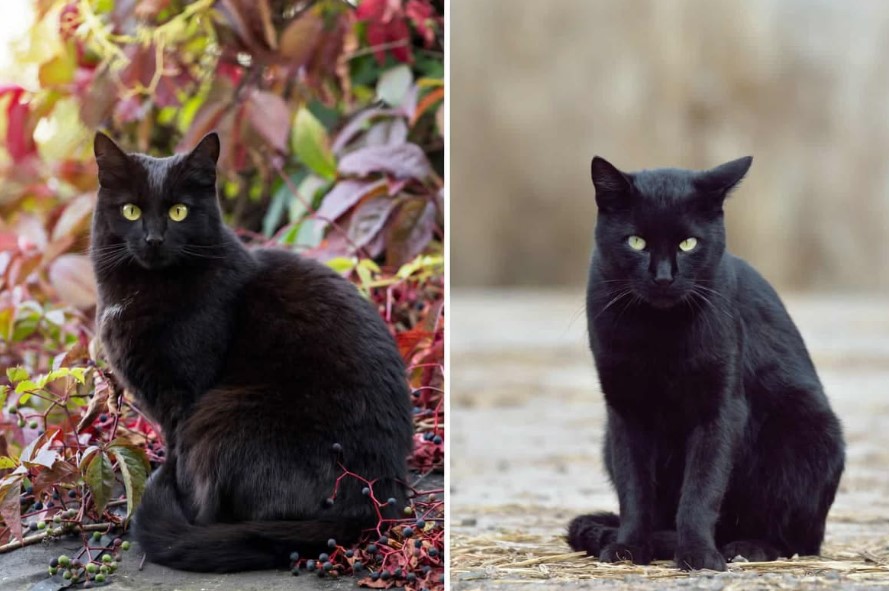
These differences become clearer when you see a true pedigree Bombay next to a typical black domestic shorthair. The Bombay’s combination of patent-leather coat, copper eyes, black extremities, and muscular density creates a distinctive “mini-panther” look that random-bred black cats rarely match exactly.
Temperament and Personality
Bombay Bombays are renowned for being extremely people-oriented, affectionate, and social—often described as dog-like. They tend to follow their owners from room to room, enjoy lap time, and many learn to fetch or walk on a harness. They are generally vocal in a soft, conversational way rather than loud. Most get along well with children, strangers, and other pets when properly socialized. They dislike being left alone for long periods and thrive in homes where someone is present much of the day. They are playful as kittens and young adults and usually remain interactive throughout life.
Black Cat (Domestic) Personality is entirely individual. Some black cats are as cuddly and social as any Bombay; others are independent, shy, or selectively affectionate. There is no breed-wide temperament because there is no breed. Shelter black cats span the full spectrum of feline personalities. Many make wonderful, loving companions, but you cannot predict temperament from coat color alone.
If you specifically want a highly social, interactive, attention-seeking black cat, a well-bred Bombay is more likely to deliver that consistent personality. If you are open to whatever personality comes with a particular cat, a black domestic cat from a shelter or rescue can be an equally rewarding choice—and often a more affordable and immediately available one.
Care Requirements
Grooming Both have low-maintenance coats if short-haired. A Bombay’s short, dense coat benefits from occasional wiping with a soft cloth or chamois to enhance the shine; weekly brushing removes loose hair. Black domestic shorthairs need similar minimal care. Longhaired black cats require more frequent brushing to prevent mats.
Exercise and Enrichment Bombays are moderately active and intelligent; they enjoy interactive play, puzzle toys, and climbing structures. Black cats’ needs vary with the individual—some are energetic, others are couch potatoes.
Living Environment Both adapt well to indoor life. Bombays particularly appreciate human company and may become lonely or develop unwanted behaviors if left isolated for long hours. Providing vertical space, window views, and daily play benefits any cat.
Diet Standard high-quality feline nutrition applies to both. Monitor weight, as muscular Bombays can become overweight if overfed or under-exercised.
Health and Lifespan
Bombay Generally healthy with a typical lifespan of 12–16 years (some reach 18–20). The main breed-related concern is hypertrophic cardiomyopathy (HCM), a heart condition that also affects many other breeds. Reputable breeders screen breeding cats via echocardiogram. Some lines may show a slightly shorter muzzle, so respiratory or tear-duct issues can occasionally appear. Routine veterinary care, dental attention, and weight management are essential.
Black Cat Lifespan and health depend entirely on genetics, care, and luck—commonly 12–18+ years for well-cared-for indoor cats. No color-specific diseases are linked to black coats. Black cats are subject to the same common feline conditions as any other domestic cat (dental disease, kidney disease, hyperthyroidism, obesity, etc.).
Neither is inherently “healthier” across the board; responsible breeding and good lifelong care matter more than breed or color.
Availability, Cost, and Adoption
Pedigree Bombay kittens from reputable, health-testing breeders typically cost several hundred to a couple of thousand dollars and may involve a waiting list. Adult Bombays occasionally become available through breed rescues.
Black cats of mixed or unknown ancestry are among the most common cats in shelters. Adoption fees are usually low, and many wonderful black cats wait longer for homes because of lingering superstitions. Choosing to adopt a black cat can be both an affordable and a compassionate decision.
Myths and Misconceptions About Black Cats
Black cats have long been associated with superstition in some cultures—bad luck in parts of the West, good luck in others. These beliefs have no basis in reality and have historically contributed to lower adoption rates for black cats. In truth, coat color has no effect on personality, intelligence, or the quality of companionship a cat offers. Many black cats (including Bombays) are among the most affectionate and engaging pets.
Which Should You Choose?
Choose a Bombay if you specifically want:
- A predictable, highly social, people-oriented personality
- The classic mini-panther look with copper eyes and patent-leather coat
- A pedigreed cat from a known background with health screening
Choose a black domestic cat if you:
- Are open to a range of personalities and body types
- Prefer to adopt from a shelter or rescue
- Want a lower cost and the chance to give a home to a cat that may wait longer for adoption
- Do not need breed-standard appearance
Many people happily live with both—enjoying the consistency of a Bombay while also opening their home to a black mixed-breed cat.
Frequently Asked Questions
Is every black cat a Bombay? No. Only cats that meet the breed standard and come from registered Bombay lines are Bombays. Most black cats are domestic shorthairs or other breeds.
How can I tell if a black cat is a Bombay? Look for a glossy jet-black coat to the roots, copper-to-gold eyes, black nose and paw pads, muscular compact build, and (ideally) registration papers or known pedigree. Without papers, visual identification alone is not definitive.
Do Bombay cats have different personalities from ordinary black cats? Bombays as a breed tend to be more consistently social and interactive. Individual black domestic cats vary widely.
Are Bombays hypoallergenic? No. No cat breed is truly hypoallergenic.
Do black cats have more health problems? No. Color itself does not cause health issues. Bombays have some breed-related risks (primarily HCM screening), while random-bred black cats have the general risks of the domestic cat population.
Why do some black cats look brown in sunlight? Many genetically black cats show a rusty or brownish tinge when the sun hits the coat, especially if the pigment is not completely solid to the root. True Bombays are bred to minimize this.
Are Bombays good with children and other pets? Yes, they are generally tolerant and affectionate when socialized properly.
How much does a Bombay cost compared with adopting a black cat? Pedigree Bombays usually cost significantly more than shelter adoption fees for a black domestic cat.
Do Bombay cats shed? Yes, but their short dense coat sheds moderately and is easy to manage with regular light brushing.
Can a black cat from a shelter look exactly like a Bombay? Some come very close in appearance, but eye color, coat sheen, body type, and personality will still vary. Without pedigree, it is not a Bombay.
Conclusion
The Bombay cat is a purpose-bred “mini-panther” with a specific look—jet-black patent-leather coat, copper eyes, black extremities, and a muscular, people-loving personality. A black cat is simply any cat that happens to wear a black coat; its appearance, temperament, and background can vary enormously.
Both can make wonderful companions. The Bombay offers greater predictability in appearance and typically a highly social, interactive nature, at the cost of higher purchase price and the need to work with a reputable breeder. Everyday black cats offer the chance to save a life through adoption, endless individual variety, and the same capacity for love and companionship, without the constraints of a breed standard.
Whether you fall for the sleek, copper-eyed elegance of a Bombay or the unique personality of a black cat waiting in a shelter, the most important factors remain the same: matching the cat’s needs and temperament to your lifestyle, providing proper care, and opening your heart to a feline friend. Coat color or pedigree papers matter far less than the bond you build together. In the end, a loved cat—Bombay or black, pedigreed or mixed—is simply a great cat.