
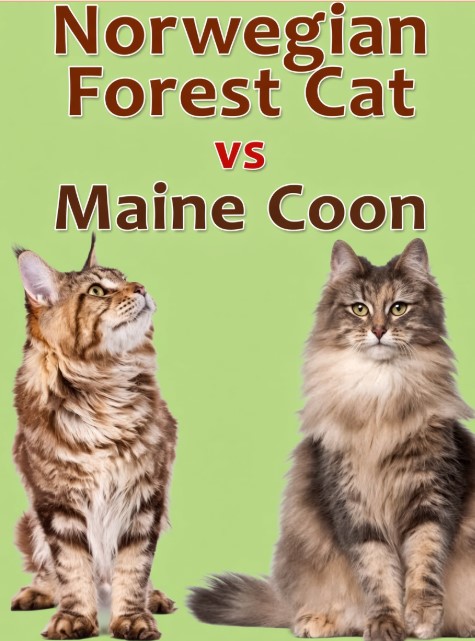
Two of the most impressive and beloved large cat breeds in the world are the Norwegian Forest Cat and the Maine Coon. Both are hardy, longhaired “gentle giants” with origins tied to cold northern climates, tufted ears, bushy tails, and striking semi-long coats. At a glance they can look similar, which often leads potential owners to wonder how they truly differ and which might be the better fit for their home.
This in-depth comparison examines every major aspect of the two breeds—history and origin, size and physical appearance, coat and grooming needs, temperament and personality, activity level, health considerations, lifespan, care requirements, and suitability for different households. By the end, you will have a clear understanding of the Norwegian Forest Cat (often called the “Wegie”) versus the Maine Coon so you can make an informed decision.
Origin and History
Maine Coon The Maine Coon is America’s native longhaired cat and is widely regarded as the largest domesticated cat breed. Its exact origins are uncertain, but popular theories involve longhaired cats brought by seafarers (possibly Viking or English) interbreeding with local short-haired cats in the northeastern United States, particularly Maine. The breed developed naturally in a harsh climate, resulting in a robust, weather-resistant cat. Maine Coons gained popularity in the 19th century as farm cats and early cat-show competitors. They nearly disappeared as a distinct type in the mid-20th century but were revived by dedicated breeders and are now one of the most popular pedigreed breeds in the world.
Norwegian Forest Cat The Norwegian Forest Cat is a natural breed from Norway with roots that may stretch back centuries. Legends link them to the cats that pulled the goddess Freya’s chariot in Norse mythology. These cats lived semi-wild in Norwegian forests, developing a dense, water-repellent double coat and strong climbing ability to survive cold, wet conditions. They were recognized as a distinct breed in Norway in the 1930s, nearly lost during World War II, and then carefully restored. The breed was exported internationally in the 1970s and is now established worldwide, though it remains less numerous than the Maine Coon in many countries.
Both are considered “natural” breeds rather than the result of recent intensive selective breeding for extreme features.
Size and Build
Both breeds are substantially larger than the average domestic cat, but the Maine Coon generally takes the size crown.
- Maine Coon: Males commonly weigh 13–18 pounds and can reach 20–25 pounds or more; females typically 8–12 pounds. Body length (nose to tail tip) can approach 40 inches. They have a long, rectangular body, broad chest, and substantial bone structure. They mature slowly, often not reaching full size until 3–5 years of age.
- Norwegian Forest Cat: Males usually weigh 12–16 pounds (sometimes up to 18–20); females 8–12 pounds. They are large and muscular but typically a bit more compact and less extreme in overall mass than the biggest Maine Coons. Hind legs are often slightly longer than the front, aiding climbing. They also mature relatively slowly, reaching full size around 3–4 years.
Individual variation is significant. A large Norwegian Forest Cat can outweigh a smaller Maine Coon, but on average the Maine Coon is the bigger cat.
Head, Ears, Eyes, and Expression
Maine Coon Rectangular or slightly wedge-shaped head with high cheekbones and a square muzzle. Large, well-tufted ears set high and wide, often with prominent lynx tips. Eyes are large and expressive, slightly oval to round, set at a mild angle. The overall look is friendly and somewhat “wild” yet approachable.
Norwegian Forest Cat More equilateral triangular head with a straight profile from forehead to nose. Ears are large, tufted, and follow the triangle of the head; lynx tips are present but often less dramatic than in Maine Coons. Eyes are almond-shaped and slightly oblique, giving an alert, forest-cat expression. The face appears more refined and wild compared with the broader Maine Coon muzzle.
Coat and Grooming
Both have impressive semi-long double coats adapted to cold weather, but the texture and distribution differ.
Maine Coon Shaggy, silky, and uneven. Fur is shorter on the shoulders and longer on the stomach, britches, and tail. A full ruff frames the neck. The coat is water-resistant but less densely woolly than the Norwegian’s. It requires regular brushing (several times a week, daily during heavy shed) to prevent mats, especially in friction areas.
Norwegian Forest Cat Dense double coat with a woolly undercoat for insulation and a glossy, water-repellent topcoat. The coat is more uniform in length and feels smoother. A pronounced ruff, ear furnishings, and bushy tail are characteristic. Seasonal shedding (especially spring) can be heavy; thorough brushing two to three times a week is usually sufficient, with increased frequency during coat blows.
Neither breed is low-maintenance. Both benefit from a good metal comb and slicker brush, plus occasional professional grooming if mats become problematic. Bathing is rarely needed if the coat is kept detangled.
Temperament and Personality
This is often the deciding factor for owners.
Maine Coon Frequently described as “dog-like.” They are highly social, people-oriented, and enjoy following their humans from room to room. Many chirp, trill, and “talk” with a soft, varied vocabulary rather than loud meows. They are playful well into adulthood, good with children and other pets when socialized, and generally confident. While affectionate, they are not typically extreme lap cats; they prefer to be nearby rather than constantly held.
Norwegian Forest Cat Affectionate and loyal but more independent and reserved than the Maine Coon. They form strong bonds with their family yet are less likely to demand constant attention. Wegies are intelligent, curious, and excellent climbers—they often prefer high perches. They tend to be quieter and communicate more through body language. With proper socialization they are gentle with children and can coexist with other animals, though they may take longer to warm up to strangers.
Both breeds are generally gentle giants. The Maine Coon is the more overtly social and interactive companion; the Norwegian Forest Cat offers a quieter, more self-sufficient presence.
Activity Level and Environment
Both need daily play and climbing opportunities. Maine Coons often enjoy interactive games, fetch, and puzzle toys. Norwegian Forest Cats particularly appreciate vertical space—cat trees, shelves, and window perches—because of their strong climbing instinct. Neither is a sedentary lap cat; both benefit from regular play sessions to maintain healthy weight and mental stimulation. They adapt well to indoor living when enrichment is provided, though many enjoy supervised outdoor time in secure environments.
Health and Lifespan
Maine Coon Average lifespan 10–13 years (some reach 15+). Common concerns include hypertrophic cardiomyopathy (HCM—genetic testing available), hip dysplasia, spinal muscular atrophy (SMA—also testable), and a tendency toward obesity if overfed or under-exercised. Responsible breeders screen for HCM and SMA.
Norwegian Forest Cat Average lifespan often cited as 12–16 years. Key genetic concern is glycogen storage disease type IV (GSD IV), a serious condition that is DNA-testable; reputable breeders test and avoid producing affected kittens. HCM and hip dysplasia can also occur. Overall they are considered robust.
Both breeds benefit from annual veterinary check-ups, weight management, dental care, and, when possible, echocardiograms as they age. Choosing health-tested parents significantly reduces risk.
Care Requirements Summary
- Grooming: High for both; Maine Coons may need slightly more frequent attention to prevent mats.
- Exercise/Play: Moderate to high; daily interactive sessions and climbing structures.
- Diet: High-quality food appropriate for large breeds; monitor portions to prevent obesity.
- Environment: Vertical space is especially valued by Norwegian Forest Cats; both enjoy window views and interactive toys.
- Training: Both are intelligent and can learn tricks or leash walking with positive reinforcement. Maine Coons often respond more eagerly to interactive training.
Which Breed Is Right for You?
Choose a Maine Coon if you want a highly social, dog-like companion that enjoys being involved in family activities, is generally outgoing, and thrives on interaction.
Choose a Norwegian Forest Cat if you prefer a slightly more independent, quieter cat that still bonds deeply, loves to climb, and has a wilder, more reserved elegance.
Both make excellent family pets for homes that can accommodate a large, longhaired cat and commit to grooming and enrichment. Visit breeders or breed rescues, meet adult cats when possible, and prioritize health testing and temperament over pure size or color.
Frequently Asked Questions
Which is bigger, Maine Coon or Norwegian Forest Cat? Maine Coons are generally larger and longer on average, though individual Norwegian Forest Cats can be very substantial.
Do they get along with dogs and children? Yes, both breeds are typically gentle and tolerant when properly socialized. Supervision with young children is always recommended.
How much grooming do they need? Several thorough brushings per week for both, more during shedding seasons. Mats can form if neglected.
Are they hypoallergenic? No. Both shed and produce typical cat allergens.
Which is more active? Both need regular play. Norwegian Forest Cats often channel energy into climbing; Maine Coons into interactive games and following people.
What is the price difference? Prices vary by location, pedigree, and breeder, but Maine Coons are often slightly more expensive due to higher popularity. Expect a range of roughly $800–$2,500+ for pet-quality kittens from reputable breeders; always prioritize health and temperament over price.
Can they live in apartments? Yes, provided they receive daily play, climbing opportunities, and mental stimulation.
Do Maine Coons and Norwegian Forest Cats like water? Many individuals of both breeds show curiosity about water and have water-resistant coats, but this is not universal.
How can I tell them apart as kittens? It can be difficult. Look at head shape (triangular vs. more rectangular), ear set, and overall proportions, and ask the breeder for parent information and registration papers.
Are there mixed Maine Coon–Norwegian Forest Cats? Yes, but such mixes are not eligible for registration as either purebred and will vary in traits.
Conclusion
The Norwegian Forest Cat and the Maine Coon are two magnificent large breeds that share a rugged northern heritage, impressive coats, and gentle dispositions, yet they offer distinctly different companionship styles. The Maine Coon tends to be the more outgoing, vocal, and dog-like partner that thrives on close involvement with its people. The Norwegian Forest Cat brings a quieter independence, exceptional climbing ability, and a slightly wilder elegance while still forming strong family bonds.
Both require commitment to grooming, space for a large cat, and regular interactive play. When those needs are met, either breed can become a devoted, striking, and long-lived companion. The best choice depends on whether you prefer an interactive social butterfly or a more self-contained forest spirit. Meet individuals of both breeds if possible, work with responsible breeders or rescues who health-test, and prepare your home for a big, beautiful, longhaired friend. With the right match, you will enjoy many years of companionship with one of the feline world’s true gentle giants.